
Leather, one of the oldest materials used since virtually the dawn of time, is increasingly the subject of debate. Some question its environmental impact, while others raise concerns about its lack of animal welfare standards. But while the material is controversial, does that mean consumers’ perceptions of it are distorted? Thanks to two recent studies conducted in 2021—one French study carried out by the Alliance France Cuir, and the other a British study conducted by Leather UK, we’ll help you understand consumer attitudes. Let’s explore how consumers currently perceive leather.
Leather consumption habits
Leather consumption habits vary according to cultures and lifestyles. In some cultures, leather is considered a high-end material and is widely used in the manufacture of clothing, footwear and accessories. In other cultures, leather is less common and is often considered a luxury material reserved for special occasions. Leather consumption habits have also evolved over time, especially in today's ecological context, where consumers are encouraged to make decisions to protect the future of our planet.
Although leather is perceived as an expensive material, the majority of consumers reported that they regularly purchase leather products. Among the most popular items, shoes are the most commonly purchased leather product. The leather goods ranks second, followed by clothing and furniture.
leather goods s are purchased more often by women than by men, whereas men, conversely, buy more shoes than women.
Most leather goods are purchased at specialty retail chains, independent boutiques, and online. Next come ready-to-wear retailers, secondhand stores, luxury stores, and, at the bottom of the list, supermarkets and markets.
The main qualities of leather according to consumers

The 2 studies, the National Leather Council and Leather UK, have shown that leather has a positive image in terms of resistance and longevity, that it is a durable, natural and solid material. But above all, leather is the most resistant material, ahead of synthetic materials and other textiles.
The repairability of leather is also perceived positively, most consumers are used to repairing their leather items, and some of them buy them second hand.
The fact that leather is recognized as a natural material is a known fact among older consumers.
Properties unknown to young consumers
The fact that leather is a natural material is better known by the older population (55 years and older). On the other hand, younger consumers (18-34 years old) are unaware that leather is primarily a by-product of the food industry, and especially some think that leather is not an animal material. Even more surprising, some young consumers think that leather is a product grown in a laboratory.
Consumers who say they do not buy leather are young consumers and who invoke animal protection to justify this choice, and thus believe they are protecting the planet. This is a distorted image, because, as a reminder, leather production is the oldest recycling activity in the world. Indeed, leather is produced from the skins of animals raised for their meat or milk. Also, it is important to remember that the skin represents on average between 1 to 2% of the total value of a farmed animal. Thus, raising an animal for its skin would represent an economic model without any viability.
To demystify the preconceived ideas about the material, the French leather industry recently launched a digital campaign called " RIUC " (leather in slang) which aims, in a humorous and educational way, to invite everyone to take a fresh look at leather and demonstrate the commitment of its industry.
The consumer and alternatives to leather
In the current ecological context, we are all encouraged to make decisions to protect the future of our planet. Taking advantage of this ecological concern, some actors are adopting a marketing strategy on alternative materials to leather, combining the word "leather" with "vegan", and advocating more ecological products with a responsible consumption choice, by masking the true nature of the product in question. According to an article in Vogue Business, searches for the phrase "vegan leather" have increased by 69% in just 2 years.
But what do consumers really know about alternative materials to leather? What about the so-called "vegan" leather?

The result of the British study is very worrying, because more than half of the consumers have no idea of the composition of these different alternative materials to leather, and logically, did not know which material was the least harmful to the planet. And that when it is explained, for example, that a leather product called "vegan" is actually PVC or PU, or that the leather called "pineapple" is actually a mixture of plant and plastic, the consumer expressed a sincere disappointment and that they were really misled, even scammed.
Through this study, we understand the importance of protection and legislation on the use of the word legislation on the use of the word "leather but also of a clear labeling. In some countries, such as France, Italy, Portugal and Brazil, legislation has been passed prohibiting the labeling of the product as "leather" if it is not a material obtained from animal skin by means of tanning or impregnation that preserves the natural shape of the skin fibers. But this legislation is unfortunately not and is far from being applied in all countries.
Towards a reasoned consumption of leather
The economic crisis has given a new dimension to social and environmental issues. At a time when sustainability has become an essential criterion to be taken into account, the second-hand piece combines the virtues: limiting waste as much as waste and promoting reuse.The thoughtless consumption culture of the " Fast Fashion "has, for a while, given way to the " Slow Fashion The thoughtless consumer culture of "Fast Fashion" has, for a little while now, given way to "Slow Fashion" - an investment in quality and meaningful consideration, as well as the prioritization of "timeless" over "trendy" in favor of a society where we "take, make, and reuse" in order to maintain and ensure the economy of natural resources for as long as possible. This is better known as circular economy.
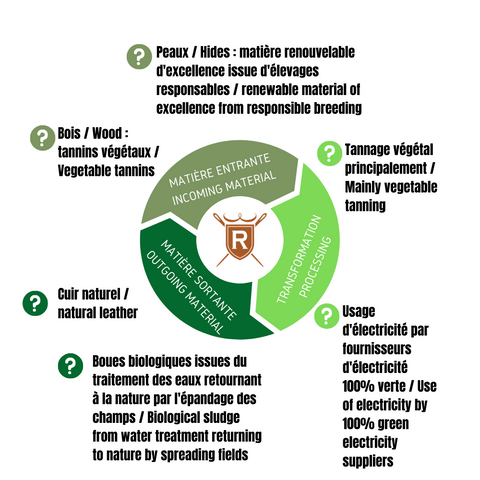
With countless communications on social networks going in the direction of "Slow Fashion", young consumers will undoubtedly drive this societal change. This is coupled with a sharp increase in second-hand sales. In the UK study, 36% are now more aware of environmental issues and impacts, and 35% said they buy clothes, shoes and accessories less frequently than they did 5 years ago.
A strong trend toward repairing items was noted in this study.
Consumers are looking for more classic, quality items that will stand the test of time and prove to be wise investments. Leather is the material of choice, with leather goods and shoes representing 50% and 1/5 of the second-hand offer respectively.
Naturally durable and long-lasting, leather products have a rightful place in the growing second-hand market.


